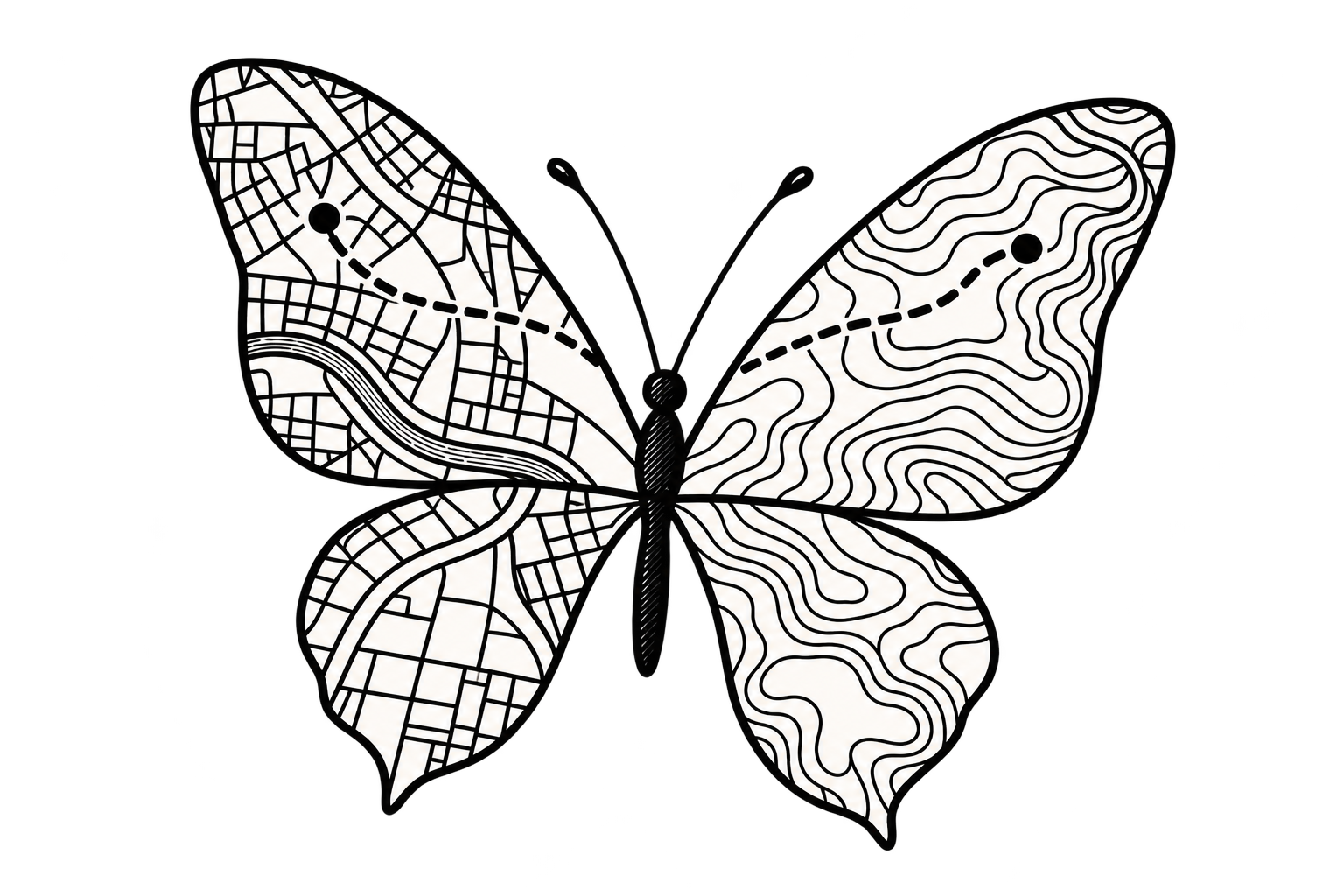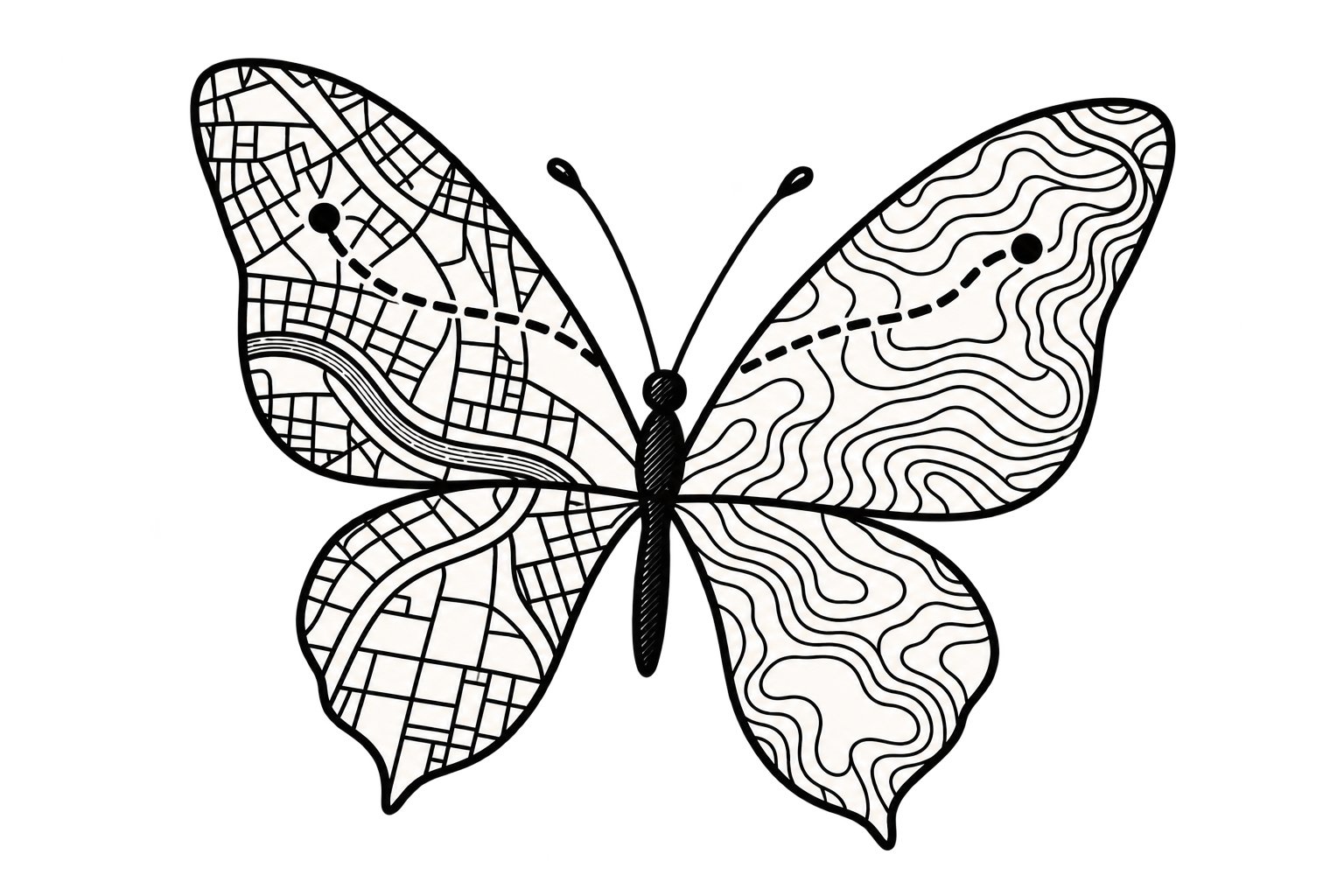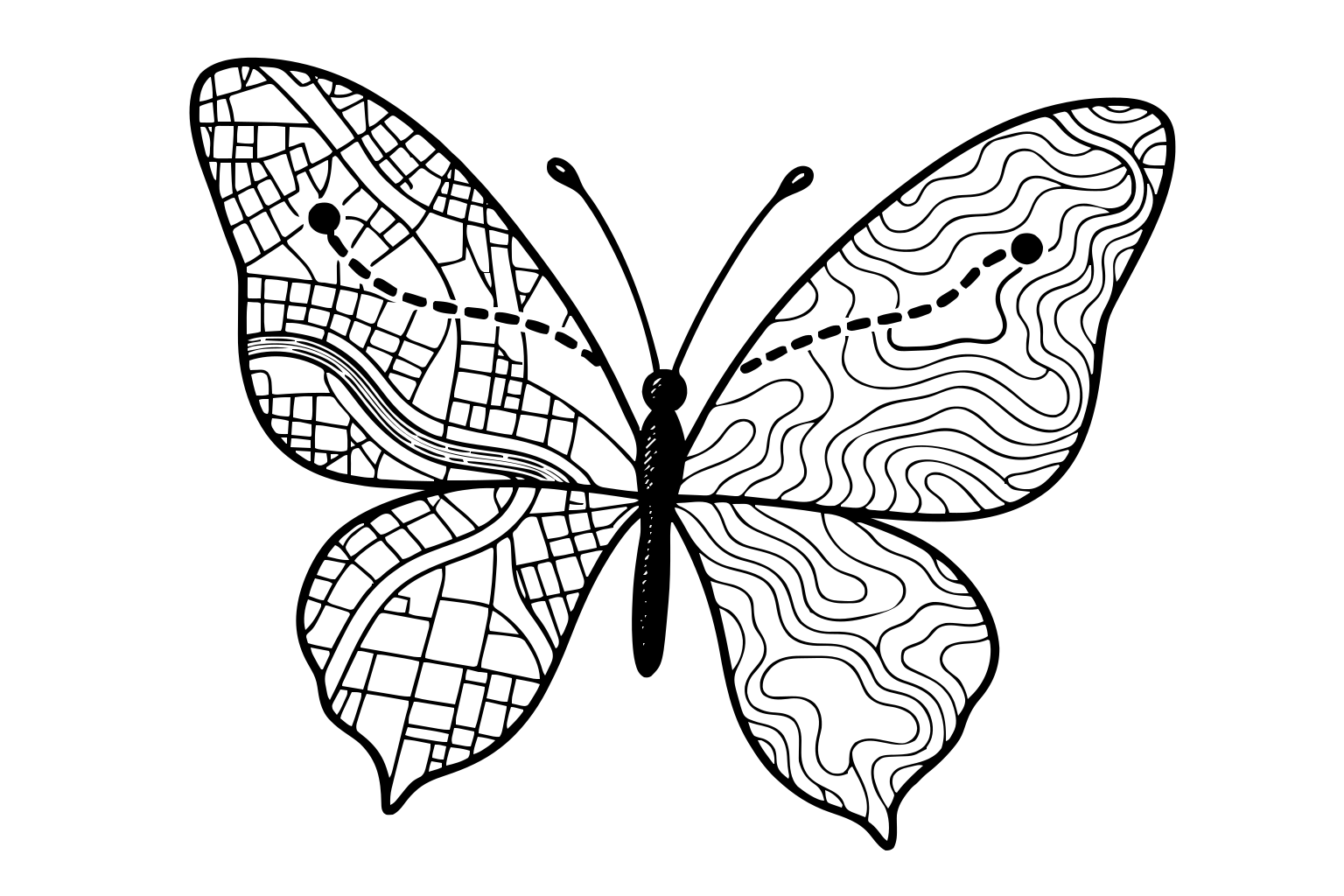
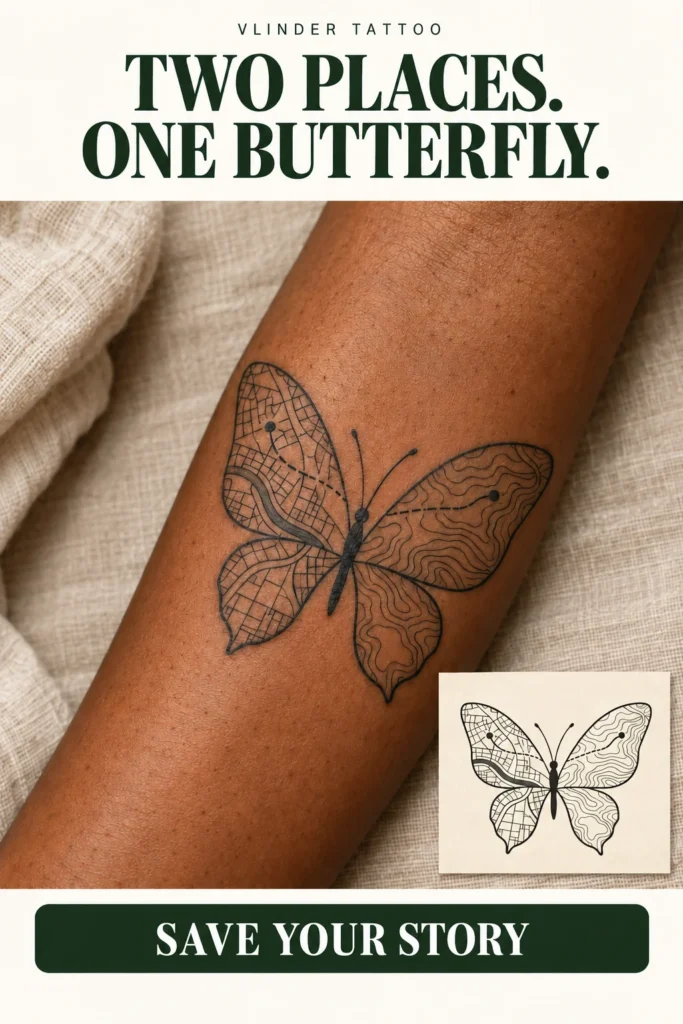
| Defining detail | Street grid and contour lines |
| Connection | Two points and a dashed route |
| Map accuracy | Decorative, not geographic data |
| Personalization | A few verified landmarks |
Separate the map from the metaphor
The supplied streets and contours are a decorative pattern. They are not a verified map of a named city or mountain. That matters if accuracy is part of your story. A motif can look convincingly cartographic without corresponding to a real place, so decide whether you want the feeling of travel or a geographically meaningful drawing.
If you want actual places, bring clear references and tell the artist which features need to remain recognizable. A river bend, a road junction, or a coastline can carry the idea with fewer lines than a whole neighborhood. Keep the real map as a separate comparison while the artist adapts it to the wings.
Keep a clear route through the detail
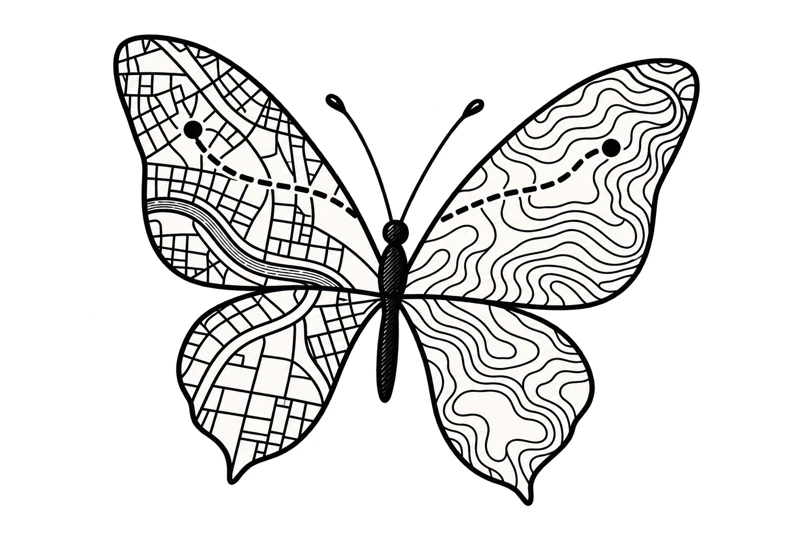
The route is darker and simpler than the surrounding line networks. It crosses the wings in short dashes, ending at two filled circles. That difference helps the eye understand the connection. If every road and contour becomes equally dark, the route loses its role as the main story line.
The butterfly body is another important divider. It separates two different pattern languages without cutting the composition into unrelated halves. When personalizing the piece, preserve a clear center and keep some open channels around it. A little empty space can make both maps easier to read.
Use a location without publishing private data
You can choose a city, a region, or a meaningful landscape without revealing an exact home address. A neighborhood outline or a public landmark may tell the story just as well. Be especially careful with coordinates if the design will appear on public boards or social profiles.
Two locations do not have to mean two countries. They could be a childhood street and a walking route, a city and a coast, or two places connected to a friendship. Write down why the pair matters before choosing labels. A design can remain specific to you without adding names inside already detailed wings.
Adapt the pattern to the placement
The open-wing format needs width. A broad forearm or upper-arm layout can show both maps together, while a narrower placement may wrap one side out of view. Ask to compare the design on a flat print and on the intended placement. The important question is whether the route still feels connected from ordinary viewing angles.
For a smaller piece, choose a few essential map lines and larger clear spaces. Do not assume that reducing the whole file preserves the same reading experience. A detailed desktop image and a small tattoo are different design problems. Let the artist simplify the geography while keeping the two-place idea intact.
Download the brief, then verify the geography
The free reference pack includes the isolated reconstruction, a simplified vector trace, printable sheets, and the supplied source image. The SVG does not contain geographic coordinates or GIS data. It is a drawing reference, so it should never be used as proof that a route is accurate.
Before approving your own version, check the two endpoints, the direction of the route, the chosen landmark, and any added words. If the design is purely symbolic, say so in the brief. If it needs to represent a real journey, give the artist a verified map and check the final drawing against it.
A few useful answers
Are these real maps?
The supplied pattern has not been tied to verified places. Use your own reliable map references if geographic accuracy is essential.
Can this be a matching tattoo?
It could be adapted for two people, but decide which features connect the pair. Matching meaning does not require identical placement or every interior line to be the same.
Yours to take to the artist
Your free reference pack.
Keep the idea, mark your preferences, and discuss the final drawing with your artist. Includes PNG, JPEG, a simplified SVG trace, A4 and US Letter sheets, and the supplied source image.
Download the free reference packA reconstructed artist reference, not exact original artwork or an approved stencil. The SVG simplifies detail. Personal-use terms apply.
Editorial note: this is visual analysis of a supplied illustrative design. Suggested meanings are personal interpretations. Reconstructed references may differ from the source and need artist review. This is not medical advice, tattooing instruction, or evidence of healed results.
Build your artist brief · Compare placements · Suggest a correction