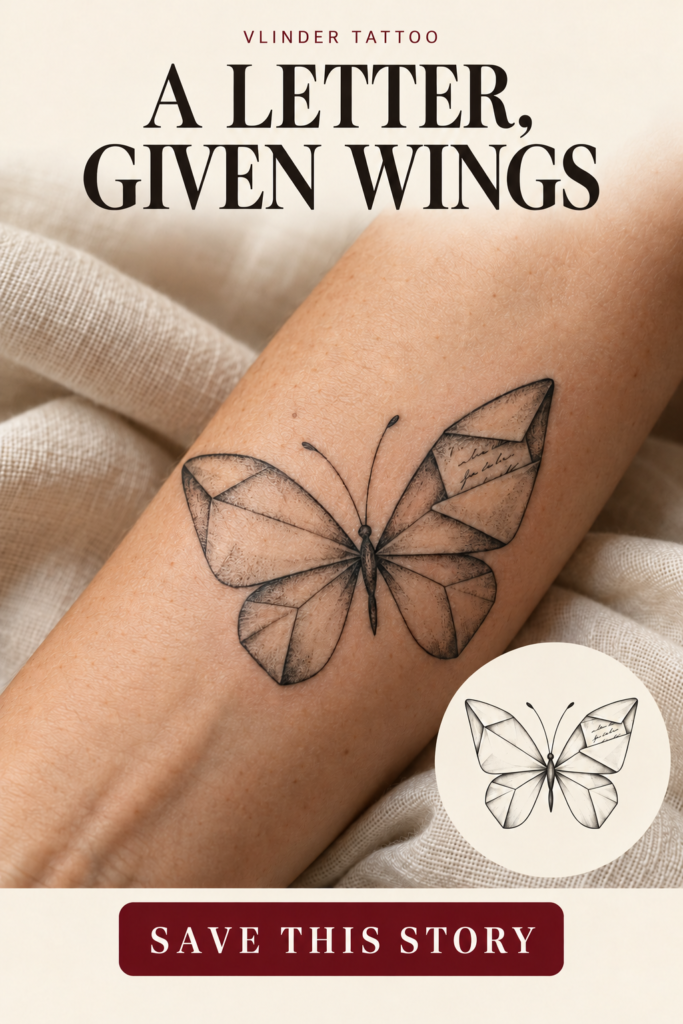
| Defining detail | Folded-letter wings |
| Visual balance | Angular above, rounded below |
| Personalization | One handwriting fragment |
| Keep open | Space around the writing |
Look closely at the folds
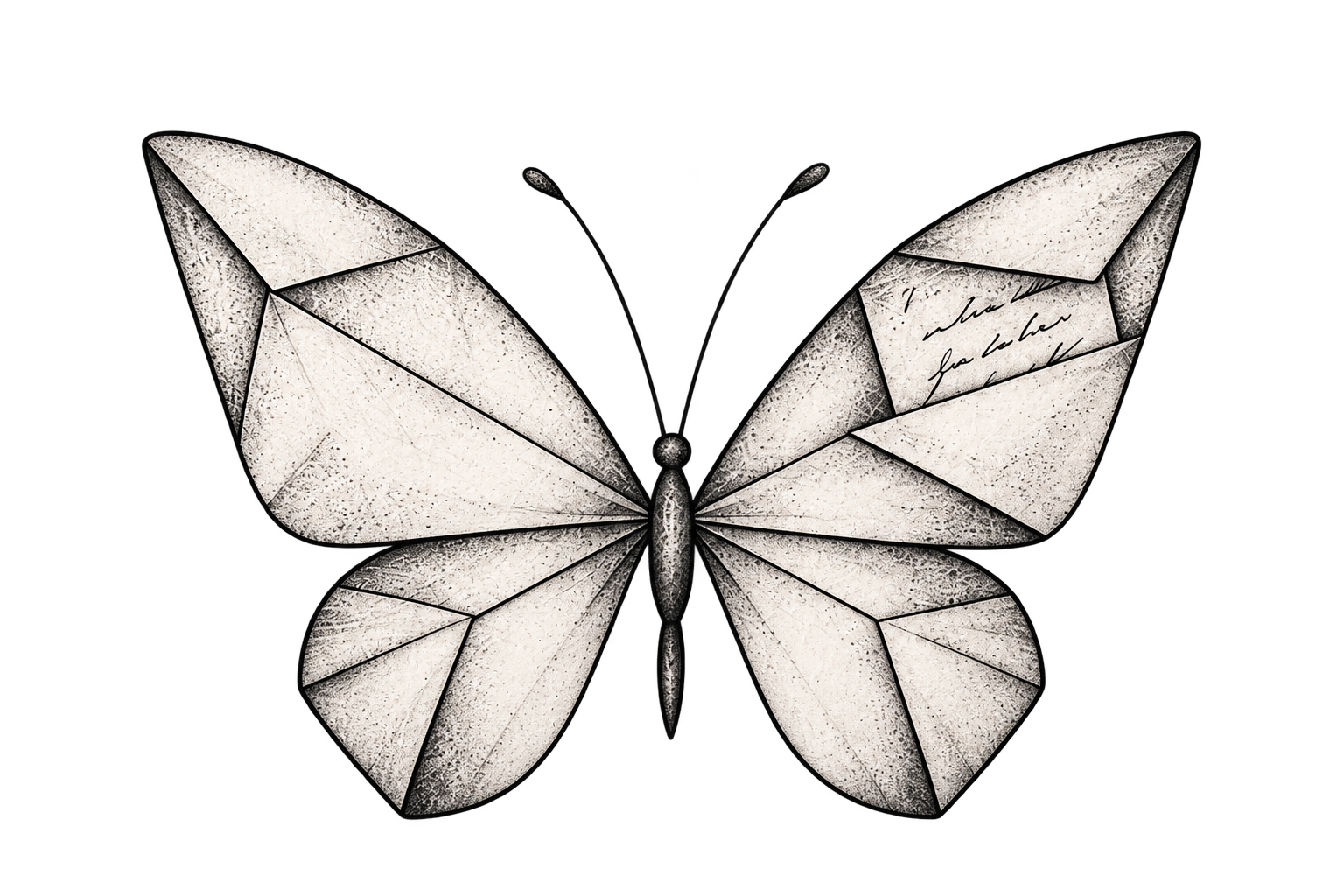
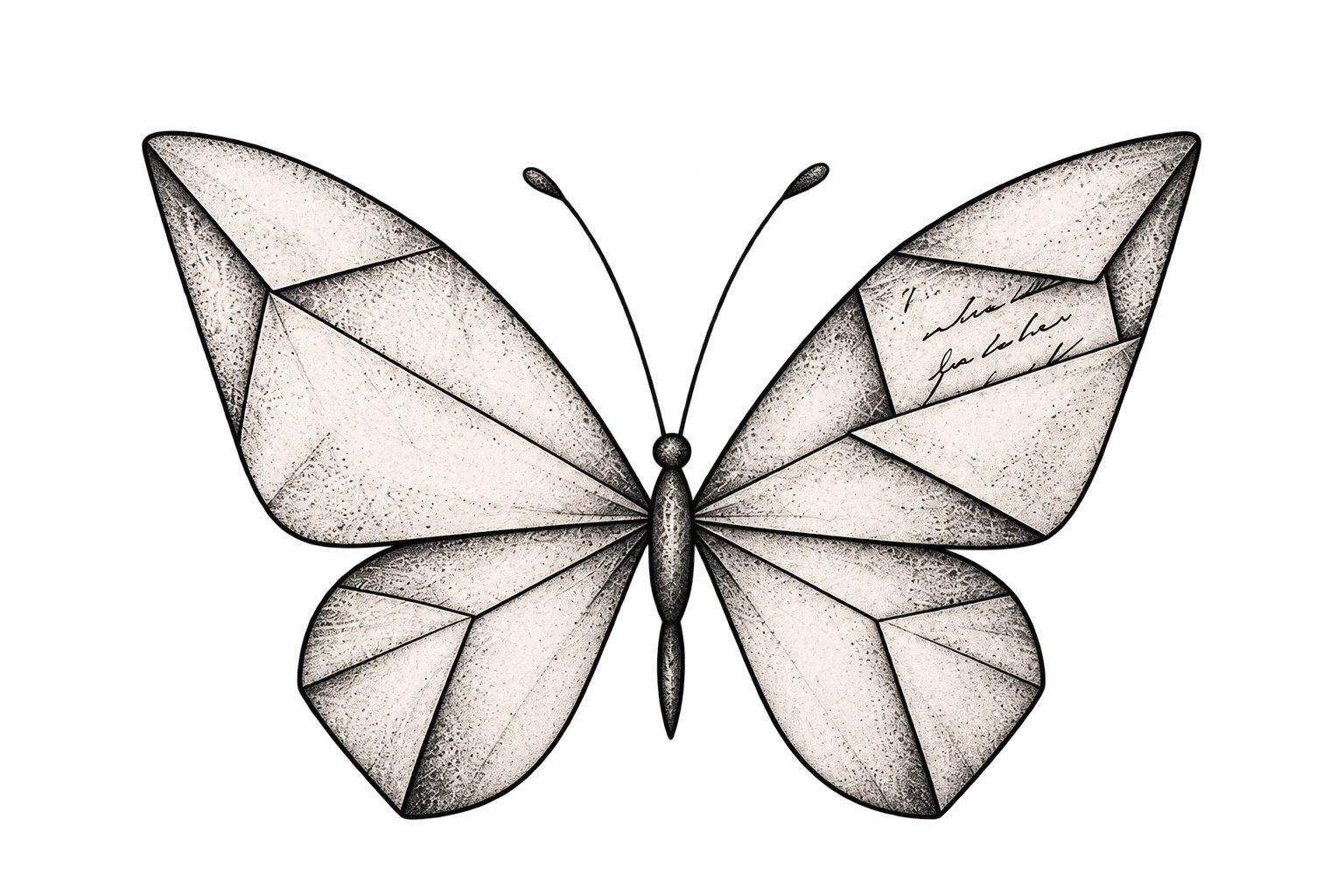
The upper wings have long, angular tips, but the lower pair are rounded. Fine diagonal lines cross the upper wings like envelope folds, creating a quiet contrast between something manufactured and something living. The body anchors those diagonals at the center. Light shading gives the paper panels a little depth without turning them into solid blocks.
The writing is a visual suggestion, not a legible quotation. Treat that distinction as a design choice. If you want actual words, supply your own clean text or handwriting sample and ask the artist to show you what remains legible at the proposed size. Enlarging a screenshot will not recover a message that was never clearly present.
Choose the message before adding symbols
This design could mark a letter from a loved one, an unsent message, a move, or a chapter you have finished. Those are possible readings, not a universal meaning attached to the butterfly. Begin with one sentence about what the piece means to you, then decide whether the writing belongs inside the wing at all.
A date, name, stamp, and quotation can quickly compete with the folds. Choose one personal detail. A few strokes of recognizable handwriting may feel more intimate than a full paragraph. Keep any document containing private names or addresses out of public inspiration boards; your artist can work from a separate, carefully selected fragment.
Give the wing tips enough room
The reference uses the forearm, where the open wings have space to spread. Test the design in the direction your arm naturally rests, then turn your wrist and look at it from both sides. Decide whether the body should follow the length of the arm or sit diagonally across it. Neither direction is automatically correct; they produce different visual rhythms.
For a smaller placement, ask for a simplified version rather than shrinking every crease and handwritten stroke together. The broad outline is the essential part. A second, cleaner version can preserve the idea with fewer interior lines. Compare both on paper before deciding which one feels like your story.
Bring a short, useful brief
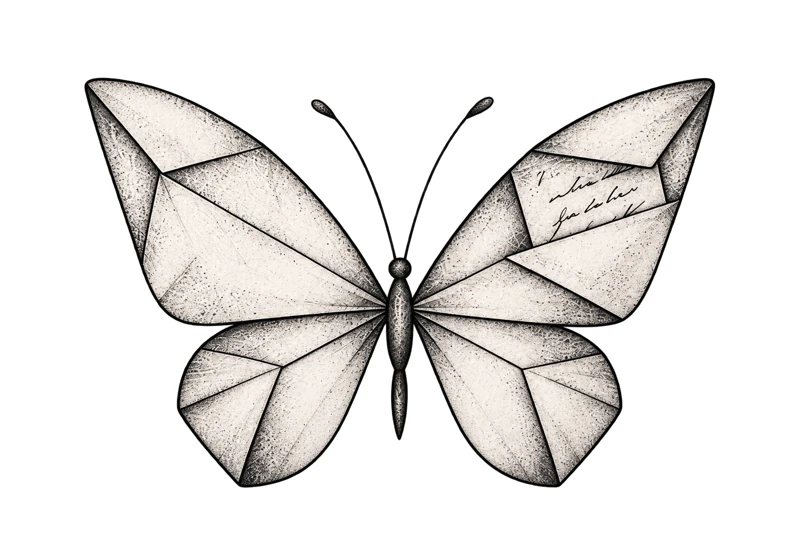
Show the artist the source image and the isolated reference together. Say which features must stay: the paper geometry, the upper-right writing panel, or the contrast between pointed and rounded wings. Then identify what may change. Separating those decisions is more useful than asking for an exact copy of every mark in a photograph.
Ask to see the finished drawing at the intended size and check the spelling yourself if you add readable text. Request a normal reading view and a close view, because a design can be impressive when enlarged and crowded when seen at its actual size. The downloadable reference below gives you a starting point for that conversation.
Make the reference work for you
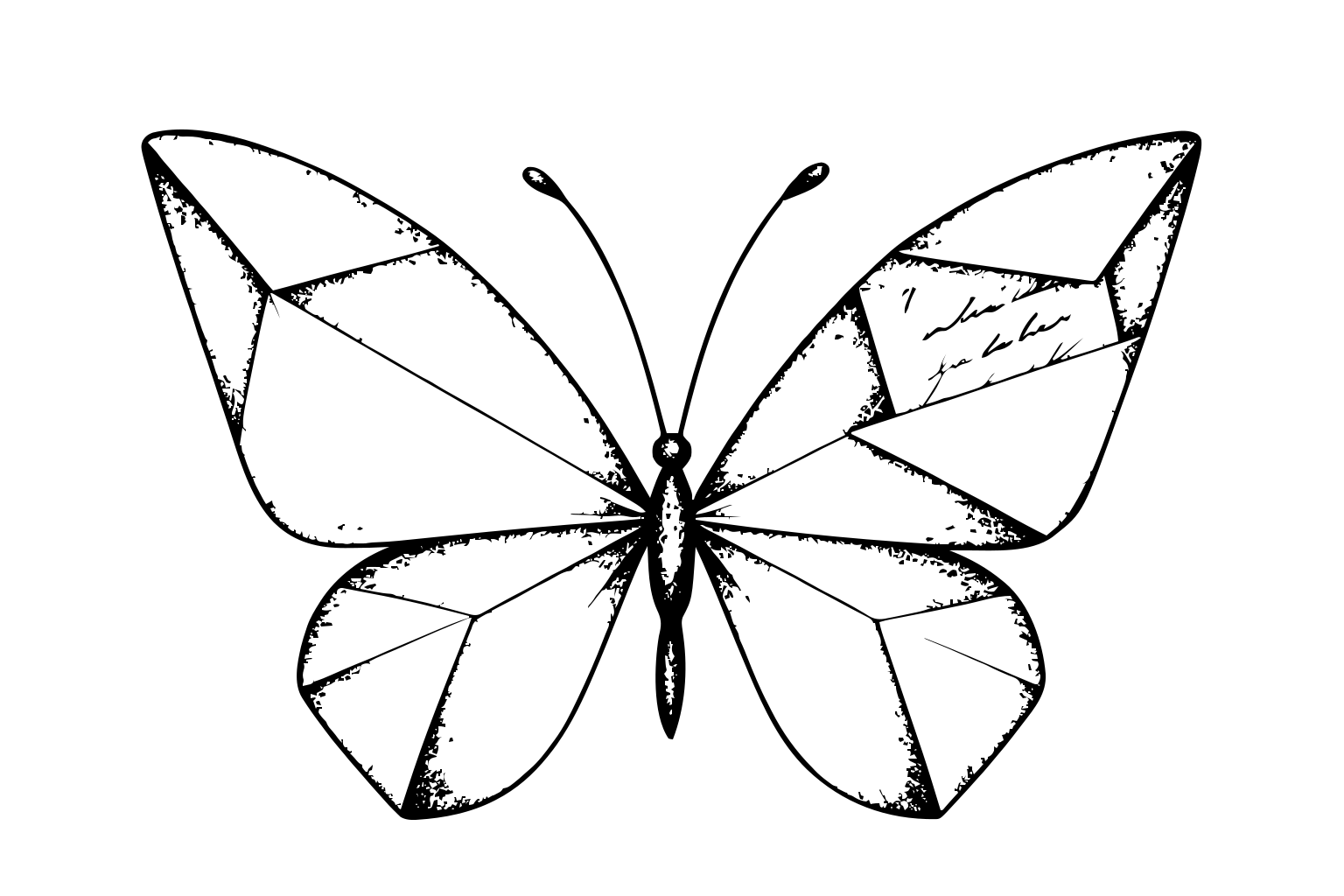
The free pack includes an isolated PNG, a white-background JPEG, an SVG line trace, and printable reference sheets. Compare them with the supplied placement image before using them. The isolated version is a reconstruction of visible artwork; tiny writing, shading, and fold angles may differ from the source.
The SVG is a simplified vector trace of the reconstructed reference. It is useful for layout and discussion, but it is not the original drawing or an approved transfer stencil. Have your artist redraw and approve the final version. A small personal design deserves that final, human check.
A few useful answers
Can I use real handwriting?
Yes, use a sample you have permission to share and ask the artist which strokes can be retained clearly at the final size. The reference does not contain a reliably readable message.
Does it have to mean a lost loved one?
No. A letter can suggest a conversation, memory, place, or private milestone. Choose the meaning yourself rather than adopting a fixed interpretation.
Yours to take to the artist
Your free reference pack.
Keep the idea, mark your preferences, and discuss the final drawing with your artist. Includes PNG, JPEG, a simplified SVG trace, A4 and US Letter sheets, and the supplied source image.
Download the free reference packA reconstructed artist reference, not exact original artwork or an approved stencil. The SVG simplifies detail. Personal-use terms apply.
Editorial note: this is visual analysis of a supplied illustrative design. Suggested meanings are personal interpretations. Reconstructed references may differ from the source and need artist review. This is not medical advice, tattooing instruction, or evidence of healed results.
Build your artist brief · Compare placements · Suggest a correction