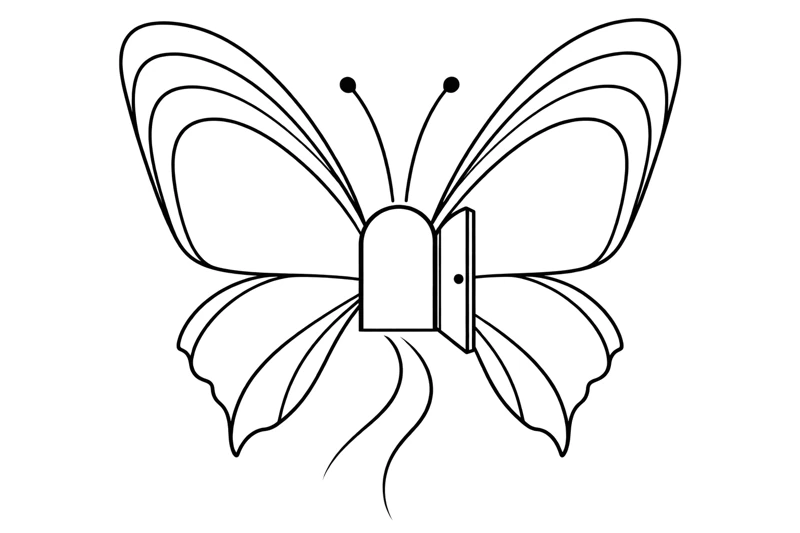
| Defining detail | Open arched doorway |
| Composition | Light wings, centered architecture |
| Orientation detail | Door opens to the right |
| Measure | Wings plus the full path |
Notice how much is left open
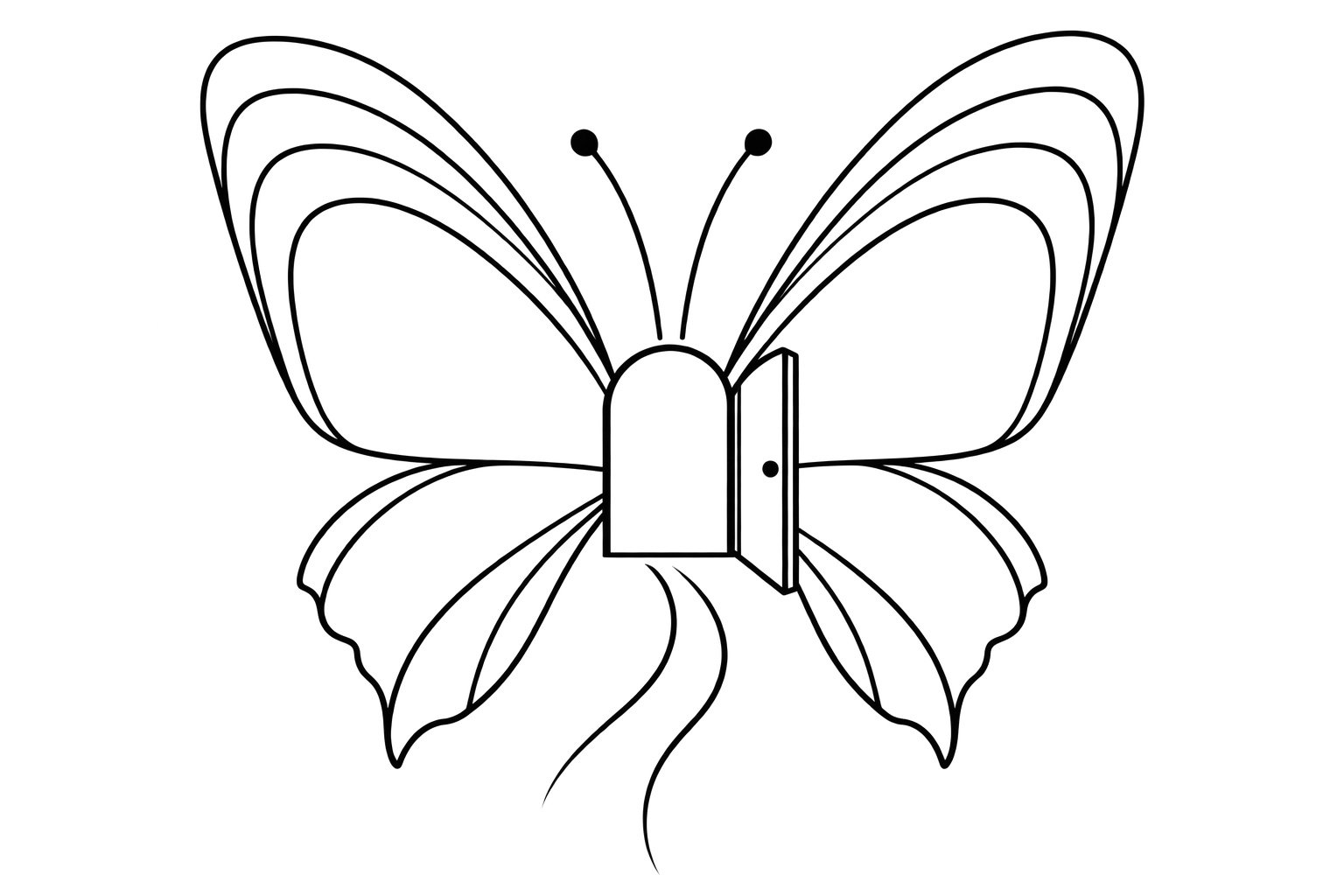
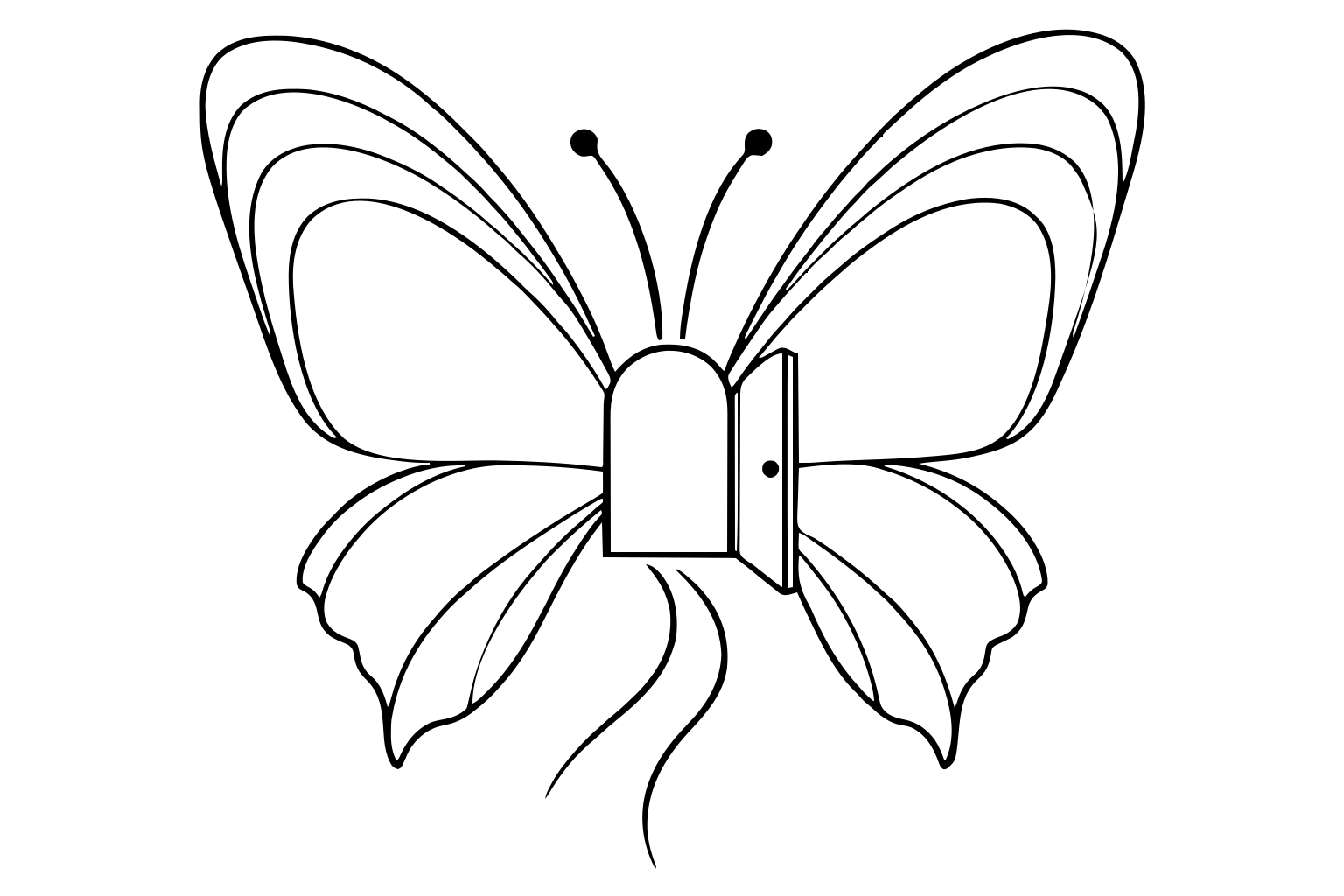
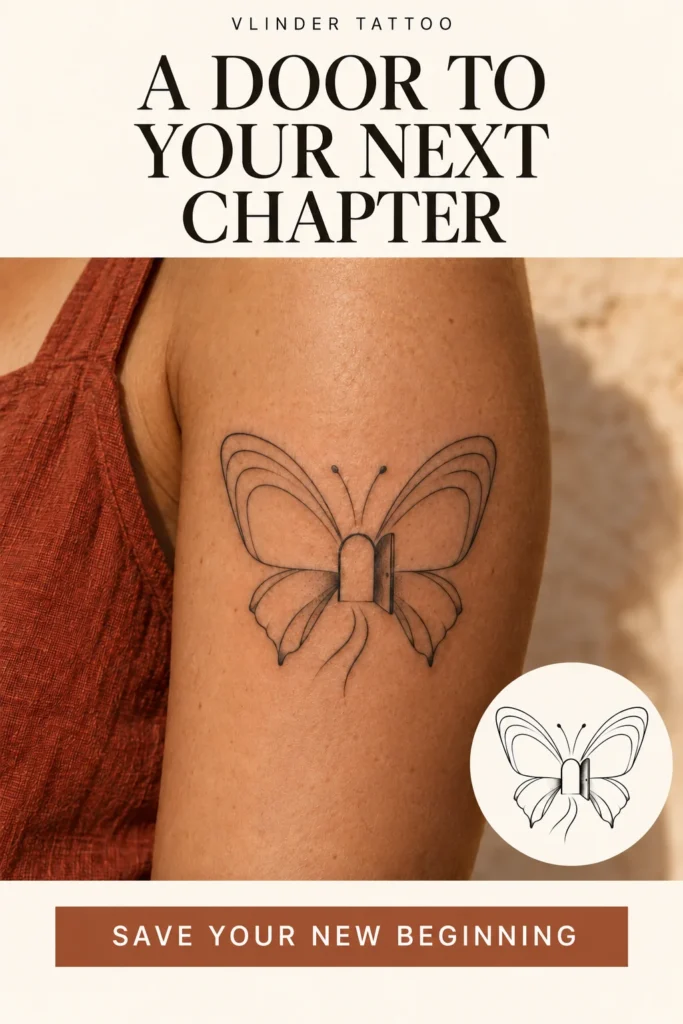
The upper wings use repeated contours rather than filled pattern. Their long curves lead toward the central arch. The lower wings are more irregular and pointed, with a few internal folds that echo the path. The door opens to the right in the supplied reference; that small asymmetry prevents the center from looking like a closed badge.
The doorway and butterfly do not have equal jobs. The wings establish the familiar silhouette, while the door gives the piece its story. If you add decoration, check that the arch still reads clearly. A tiny handle or dark door edge can do more than a cluster of stars, keys, and flowers around the outside.
Define your chapter in one sentence
An open door could suggest a move, an opportunity, a decision, or a period of personal change. These are interpretations you can choose, not fixed cultural definitions. Start with a plain sentence: what are you moving toward, or what have you left behind? You do not have to publish the answer.
That sentence can guide a restrained change. A familiar arch shape, a different door opening, or one small step might be enough. Avoid trying to illustrate every part of a life story. The composition is strongest when the reader sees one clear invitation rather than a collection of competing symbols.
Make the path a deliberate decision
The path in the reference extends under the door and curves downward. It adds height to the design and changes where its visual center sits. Measure the whole composition when discussing a placement, not just the wings. Otherwise the final path can end up closer to a crease or clothing edge than you expected.
Ask for a version with the path and one without it. Removing the path makes the butterfly more compact; keeping it makes the image feel like a small scene. Do not mirror the drawing casually. Mirroring changes which way the door opens and the direction of the path, so review the whole image after any reversal.
Compare open space and dark detail
A clean line drawing can look simple while still demanding careful proportions. Check the width of the doorway against the wings and the gap between its double contours. Ask your artist to show the drawing at its actual proposed size rather than only on a large tablet screen.
If you want a more graphic version, a darker door panel could create contrast. If you prefer a lighter piece, keep the doorway mostly open and let a narrow edge define it. Choose the version as a whole. Mixing heavy architecture with very delicate wing lines can work, but the balance needs to be intentional.
Take a reference, leave room for a final drawing
The free files below let you compare the motif without the surrounding photograph. The PNG and JPEG are reconstructed artist references. The SVG traces the visible reference shapes and is not the original editable drawing. The printable sheets leave space for notes about orientation and the doorway.
Use them to mark what must stay and what can change. Before the appointment, check the opening direction, the arch shape, the lower-wing tips, and the length of the path. Your artist should approve a final drawing for your placement. The download is a useful beginning, not a substitute for that decision.
A few useful answers
Can I remove the path?
Yes. It makes the composition more compact and shifts attention toward the doorway. Ask to compare both versions at the same wing size.
Is the design a religious symbol?
No religious meaning is asserted here. An arch and open door can carry many personal associations; you can discuss your own intended meaning with the artist.
Yours to take to the artist
Your free reference pack.
Keep the idea, mark your preferences, and discuss the final drawing with your artist. Includes PNG, JPEG, a simplified SVG trace, A4 and US Letter sheets, and the supplied source image.
Download the free reference packA reconstructed artist reference, not exact original artwork or an approved stencil. The SVG simplifies detail. Personal-use terms apply.
Editorial note: this is visual analysis of a supplied illustrative design. Suggested meanings are personal interpretations. Reconstructed references may differ from the source and need artist review. This is not medical advice, tattooing instruction, or evidence of healed results.
Build your artist brief · Compare placements · Suggest a correction