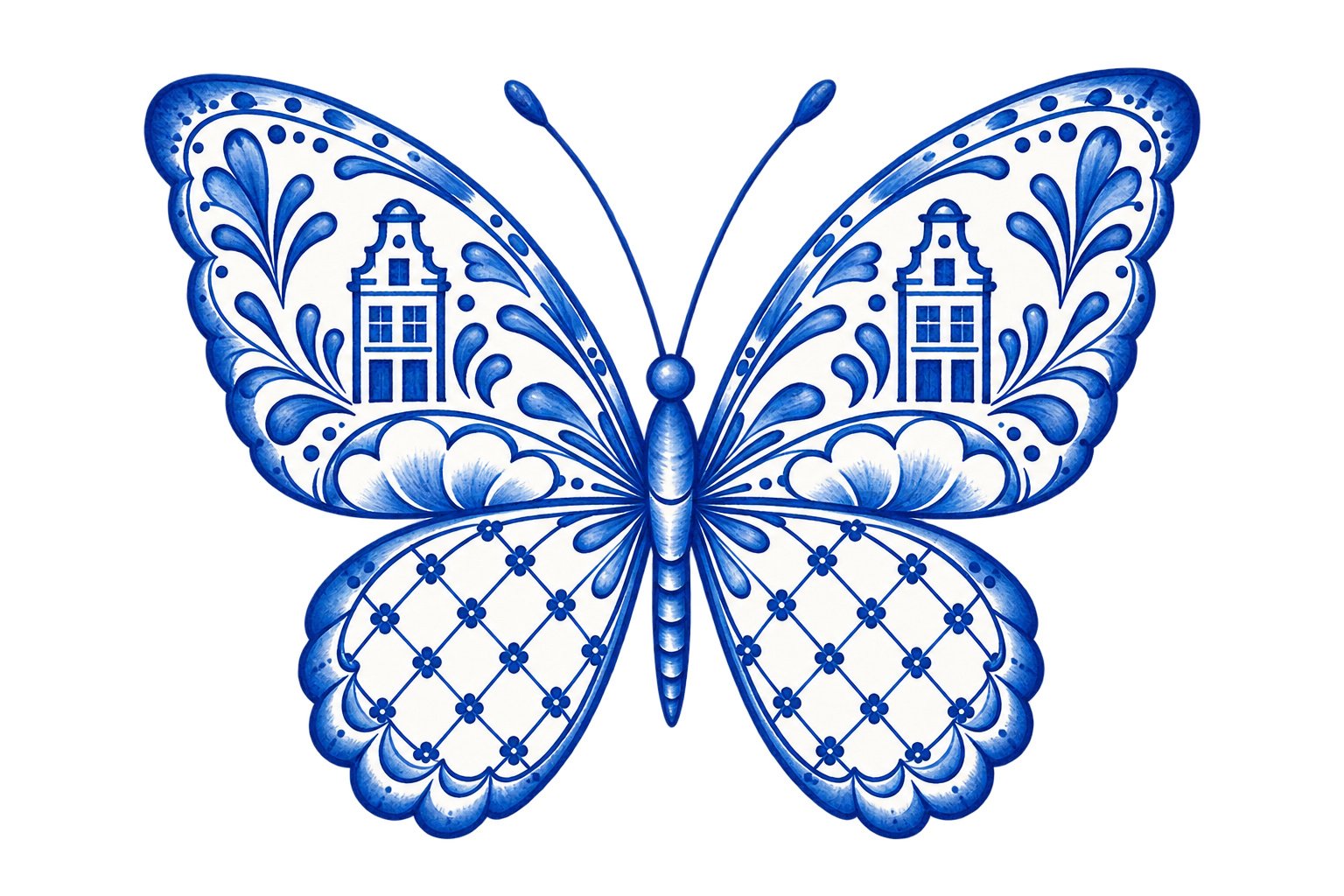
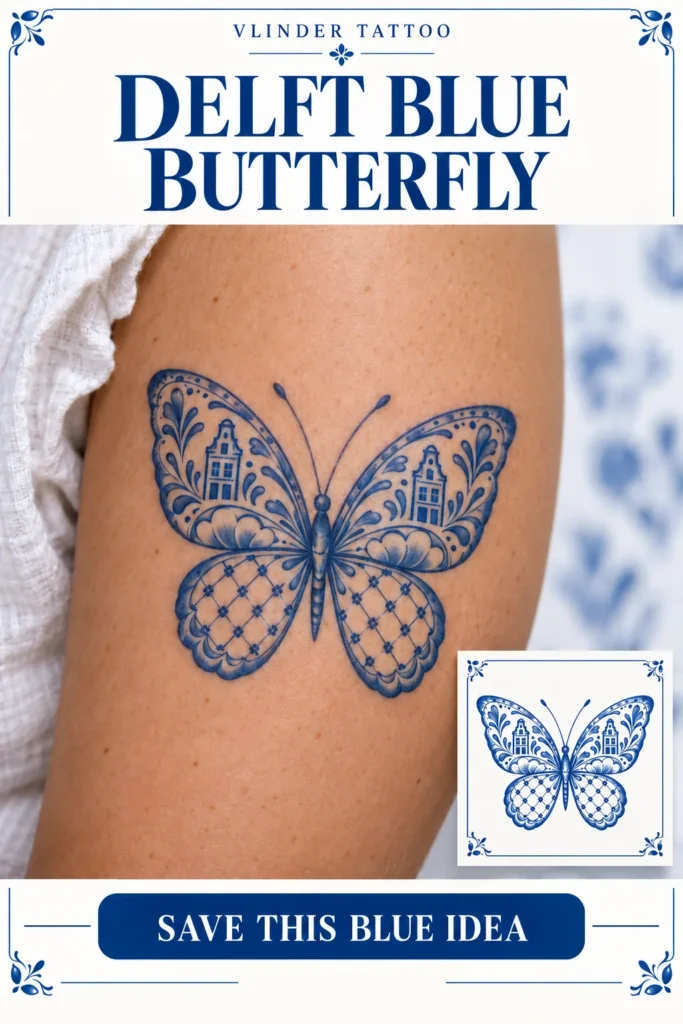
| Defining detail | Gabled houses and floral sprays |
| Palette | Cobalt and open space |
| Pattern contrast | Architecture above, lattice below |
| Simplify first | Windows and repeated intersections |
Read the design in three layers
At a distance, the piece is an open-wing butterfly. Closer up, the darker edges and floral curves define its internal structure. Only then do the little houses become visible. This hierarchy gives the eye somewhere to begin instead of asking every detail to compete at once.
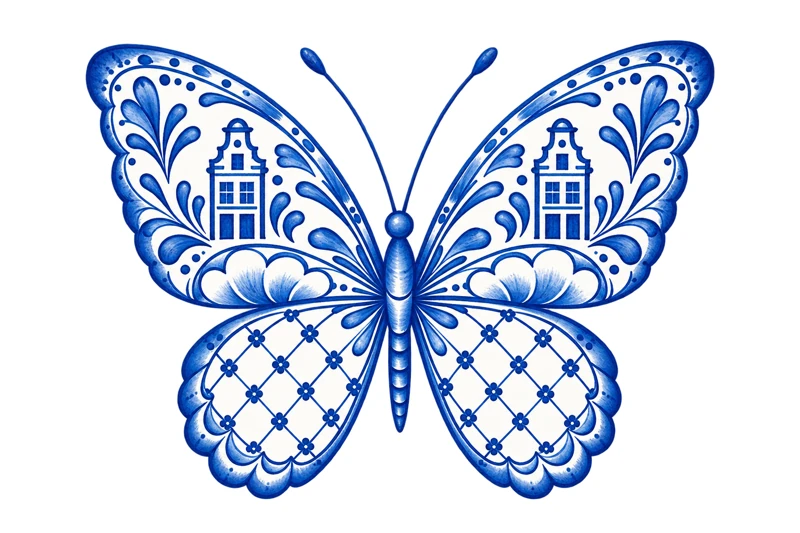
Notice that the upper wings carry the architecture and foliage, while the lower wings use a repeated lattice. The two pattern families are different but share a color and a clear outer silhouette. If you personalize the design, keep that division. Repeating the same house or flower everywhere can make the butterfly feel more like a logo than a small illustrated scene.
Use Delft as a reference, not a provenance claim
Delftware is associated with blue-and-white decorated ceramics, and its history includes influences from Chinese porcelain. The V&A's ceramics guide provides useful context for that visual tradition. This tattoo is a contemporary Delft-inspired composition; it is not a reproduction of a verified historic tile or a claim of museum authenticity.
If the idea connects to your own Dutch family history or a place you love, choose a building shape that means something specific to you. You could replace the generic gables with an artist's simplified drawing of a familiar facade. Keep a record of the source photograph and avoid presenting an invented building as an accurate landmark.
Let the pattern determine the scale
Tiny windows, leaf tips, and lattice intersections all need room in the final drawing. Begin with the smallest detail you care about, then ask your artist what overall size would support it. Starting with a tiny placement and squeezing everything inside reverses the useful order of decisions.
The upper arm in the reference offers a broad field for the open wings. A forearm version might need a narrower outline or fewer motifs. Compare a full-pattern version with one that keeps only the houses and main leaves. A simpler drawing can still be recognizably Delft-inspired when the blue palette and decorative rhythm are clear.
Discuss blue using actual work
A screen cannot show how a particular ink and drawing will look on your skin. Bring the reference to an artist who can show relevant color work, including healed examples, and talk about contrast in practical terms. Ask which parts would use a dark blue outline and which areas would remain open.
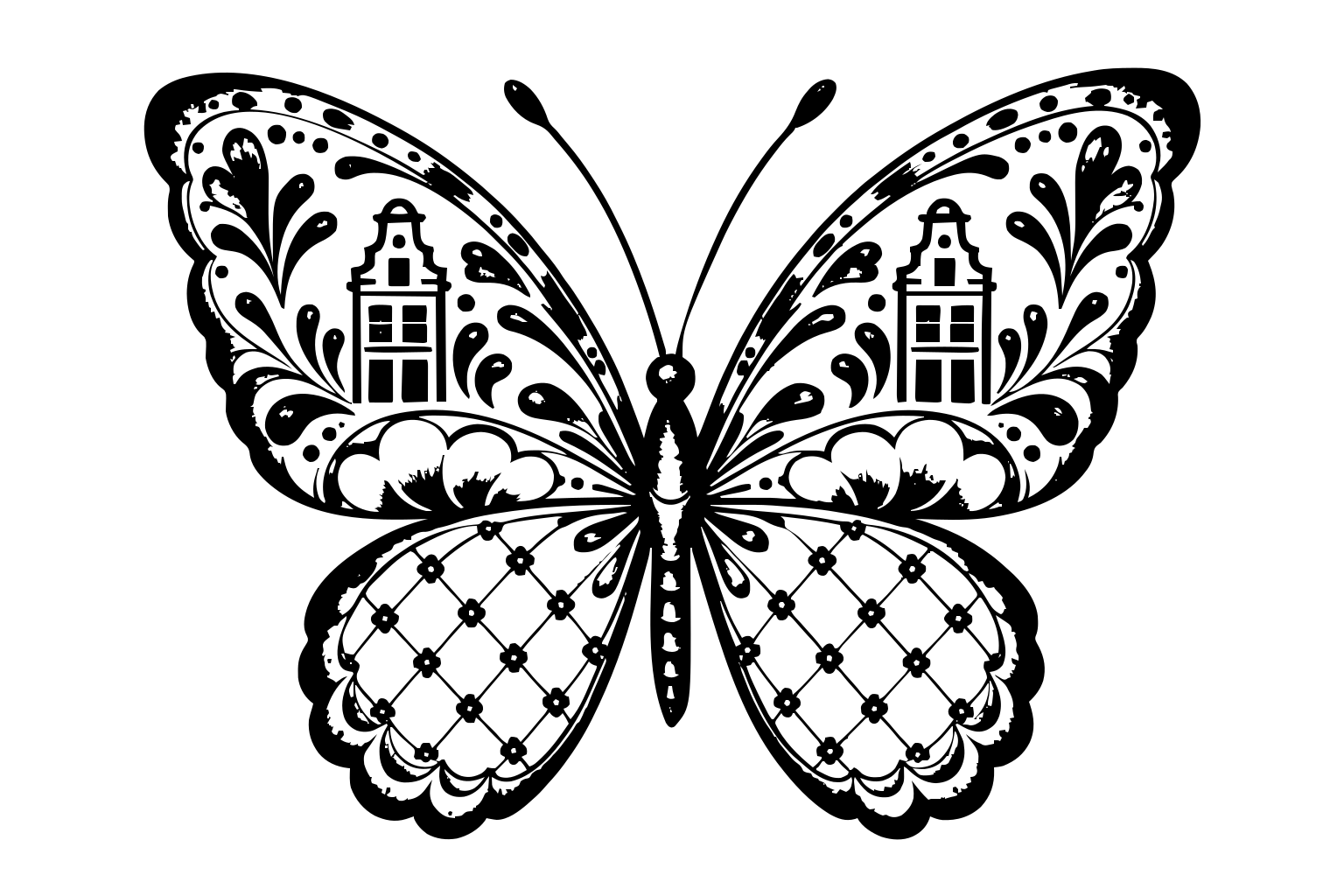
Try a monochrome paper print too. If the main silhouette disappears without the blue, the drawing may depend too heavily on color alone. The architecture, foliage, and lower-wing pattern should still be understandable as a composition. That exercise helps you decide what to simplify before committing to a final color plan.
Build a personal version with restraint
One meaningful change is enough: a different facade, a favorite flower, or a looser lower-wing pattern. Adding initials, dates, and several landmarks at once can crowd the central body. Write down your priority and let the artist solve the surrounding composition.
You can take the free reference pack to your consultation. It includes the reconstructed motif and the original supplied placement image for comparison. The traced SVG simplifies shaded blue detail and is not a color separation file. Your artist should check every small window, border, and lattice crossing before preparing a final stencil.
A few useful answers
Is this an authentic historic Delft pattern?
It is a contemporary design inspired by Delft's blue-and-white decorative language. No historic origin or museum connection is claimed.
Can the design be black instead of blue?
It can be discussed as a line drawing, but changing the color changes the Delft association. Ask for a new contrast plan rather than simply recoloring a screenshot.
Yours to take to the artist
Your free reference pack.
Keep the idea, mark your preferences, and discuss the final drawing with your artist. Includes PNG, JPEG, a simplified SVG trace, A4 and US Letter sheets, and the supplied source image.
Download the free reference packA reconstructed artist reference, not exact original artwork or an approved stencil. The SVG simplifies detail. Personal-use terms apply.
Editorial note: this is visual analysis of a supplied illustrative design. Suggested meanings are personal interpretations. Reconstructed references may differ from the source and need artist review. This is not medical advice, tattooing instruction, or evidence of healed results.
Source: V&A: An A-Z of Ceramics.
Build your artist brief · Compare placements · Suggest a correction