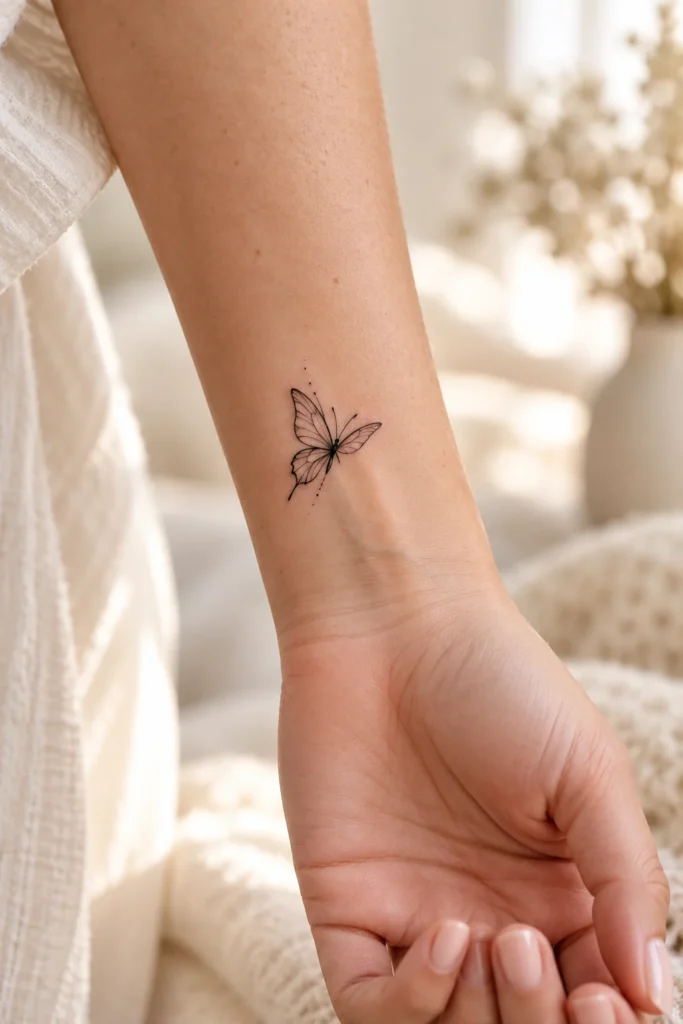
| Defining detail | Uneven wing heights |
| Placement shown | Inner wrist |
| Orientation choice | Wearer's view or outward view |
| Keep simple | One focal motif |
Read the asymmetry
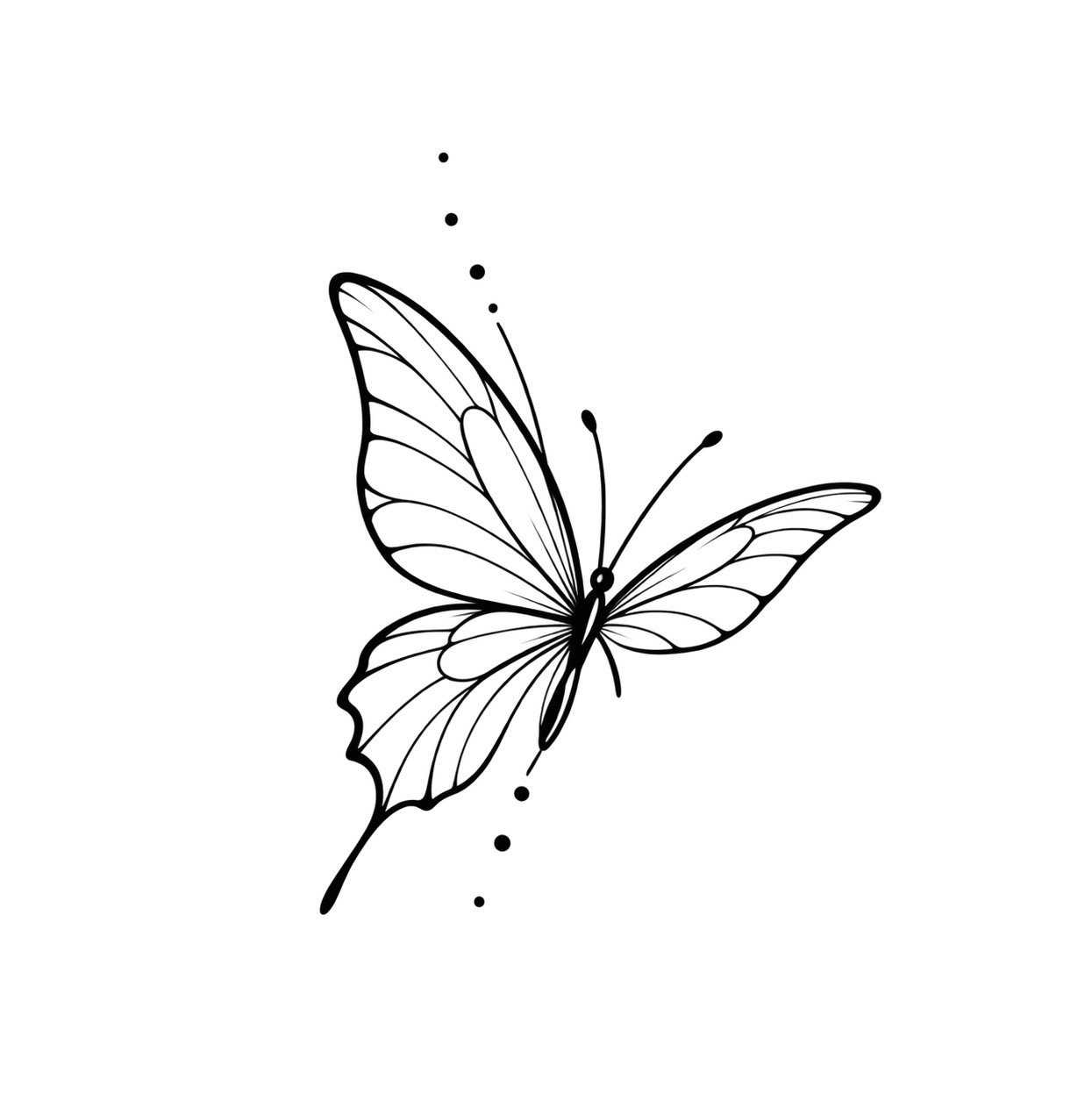
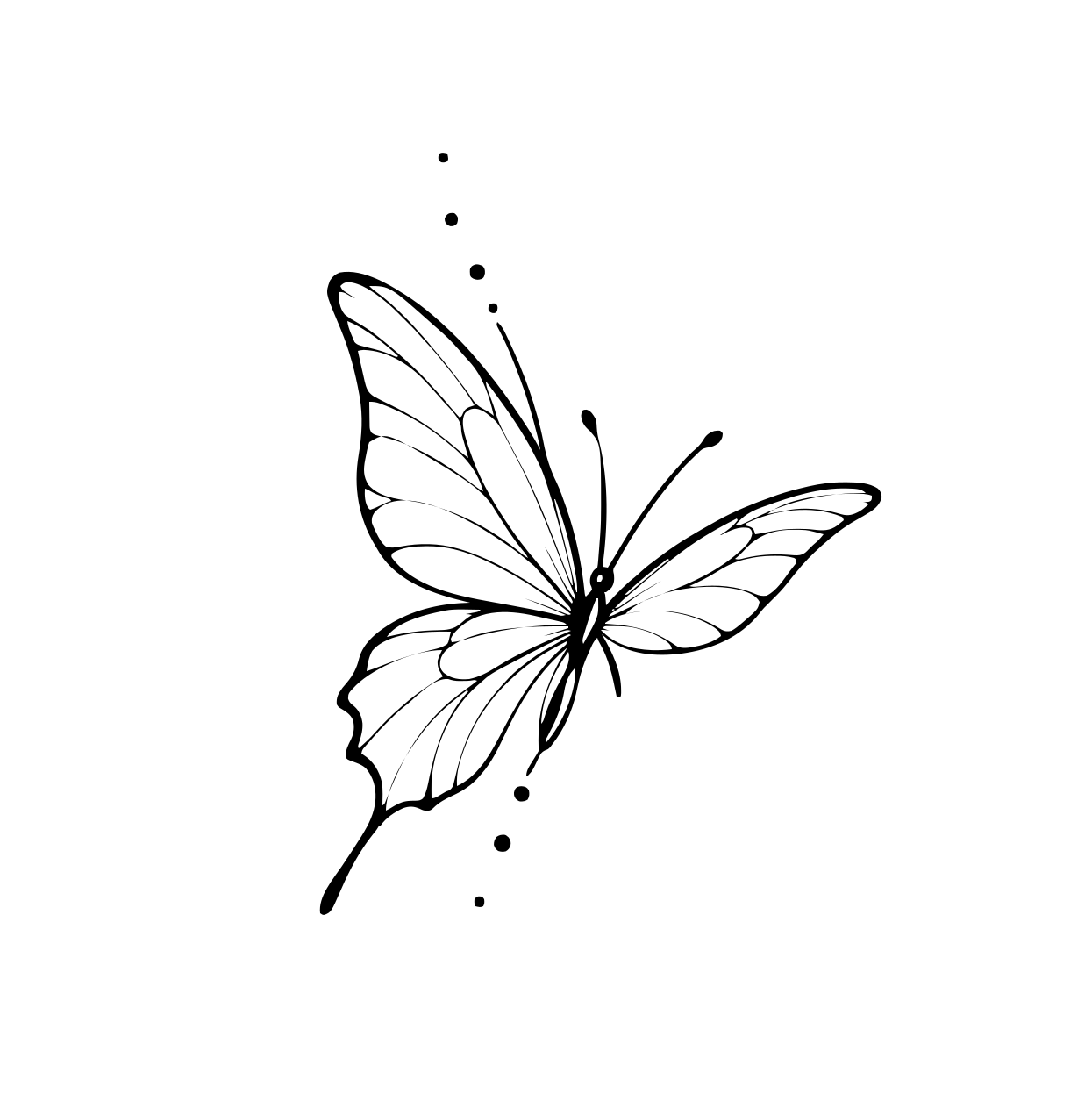
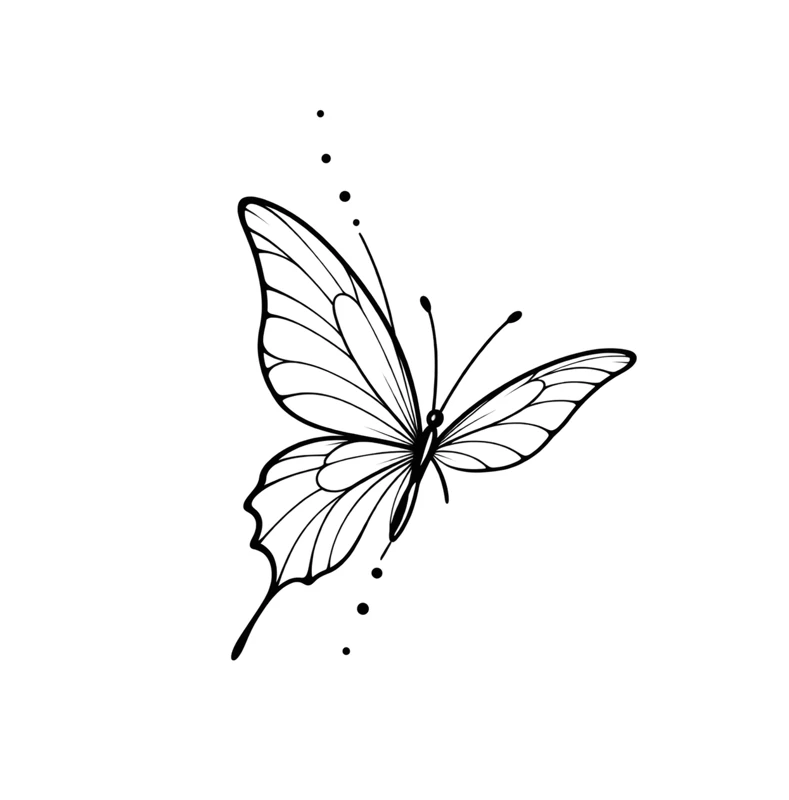
The long upper-left wing provides the main height. A narrower wing reaches to the right, and the lower edge has a more pronounced scallop. Fine veins converge near the body, which acts as a compact point of contrast. The dots are sparse enough to remain accents rather than a surrounding border.
This arrangement is worth preserving if you like the specific reference. Replacing it with a perfectly mirrored butterfly would change the character of the piece. You can simplify veins or remove a dot without losing the posture, but changing the relative wing lengths changes how the whole design feels.
Choose whose view matters most
Turn your palm upward, let the arm rest, and then hold it as you normally would when speaking. The butterfly will appear at different angles in each position. Decide whether you prefer it to face you, face outward, or follow the forearm's length. There is no universal orientation rule for a personal design.
Ask the artist to show the proposed drawing in both the straight and slightly diagonal positions. A diagonal layout can feel more fluid, while an aligned layout may feel quieter. Review the outermost points rather than just the body; the wing tips and dots define the visible space the piece occupies.
Consider watches and bracelets as part of the composition
The source image leaves the wrist mostly unadorned, so the butterfly has little visual competition. If you normally wear a watch or several bracelets, check the proposed position with those items in mind. You may prefer a little more space above the wrist or a different rotation.
Do this comparison before adding extra ornaments. An initial, moon, flower, and dotted trail can each be attractive, but the limited field around the wrist may make them compete. Choose the one detail you would miss if it were removed. Let the butterfly remain the main image rather than a frame for several unrelated symbols.
Use scale to decide what stays
Compare two paper versions from a normal viewing distance. Look first at the outline, then at the largest vein divisions. If the small details are doing all the work, ask for a cleaner drawing. The goal is not to preserve the maximum number of strokes; it is to preserve the character you liked in the reference.
The photograph does not supply exact dimensions or prove how the design was made. Avoid treating it as a specification for a particular tool or needle. A qualified artist can explain their own method, the intended line weight, and how they would adapt the image. Ask for relevant examples rather than a promise of a perfect copy.
Use the free files to make decisions
The downloadable pack includes the supplied image and a reconstructed isolated motif in several formats. The PNG is useful for layout, the JPEG for ordinary viewing, and the printable sheets for taking notes. The SVG is a simplified trace, so it should be checked against both the reconstructed reference and the source.
Mark your preferred direction, any dots you want removed, and the relationship to a watch or bracelet. Those notes turn an inspiration image into a brief. Your artist should approve the final drawing and exact position before it becomes a tattoo; the download is not a finished transfer stencil.
A few useful answers
Which way should the butterfly face?
Choose based on how you want to see it and how it follows your arm. Compare both directions on the actual placement before deciding.
Can I remove all the dots?
Yes. The wing silhouette and main veins carry the design. Removing the dots creates a more compact version without requiring a new overall concept.
Yours to take to the artist
Your free reference pack.
Keep the idea, mark your preferences, and discuss the final drawing with your artist. Includes PNG, JPEG, a simplified SVG trace, A4 and US Letter sheets, and the supplied source image.
Download the free reference packA reconstructed artist reference, not exact original artwork or an approved stencil. The SVG simplifies detail. Personal-use terms apply.
Editorial note: this is visual analysis of a supplied illustrative design. Suggested meanings are personal interpretations. Reconstructed references may differ from the source and need artist review. This is not medical advice, tattooing instruction, or evidence of healed results.
Build your artist brief · Compare placements · Suggest a correction