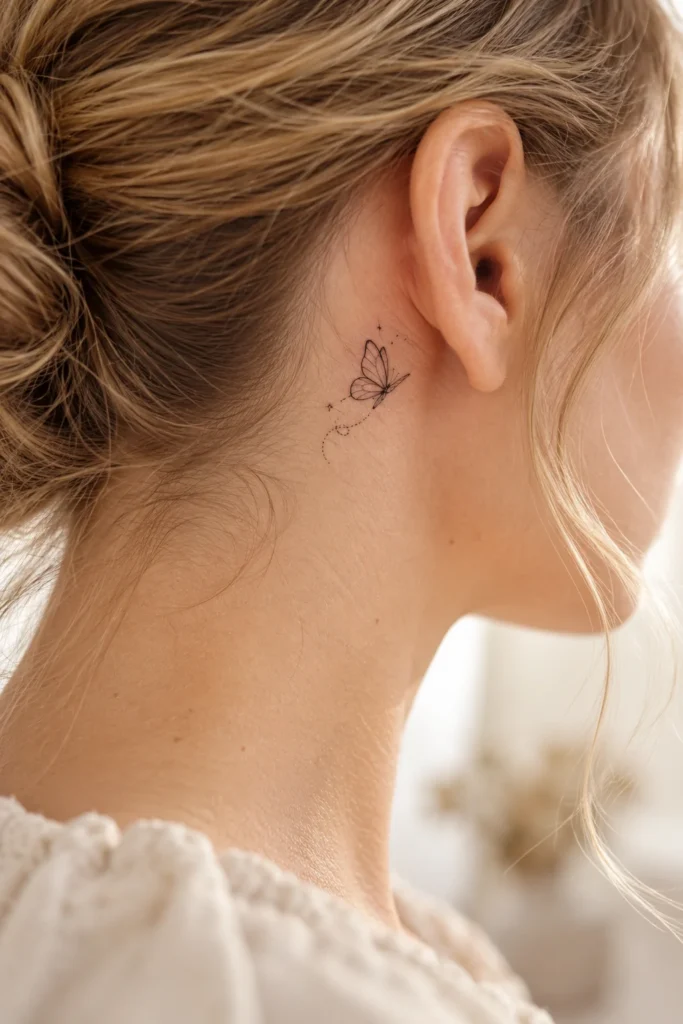
| Defining detail | Looping dotted flight path |
| Accent | One small star |
| Daily context | Hair, glasses and earrings |
| Simplify | Trail length and wing veins |
Read the whole trail
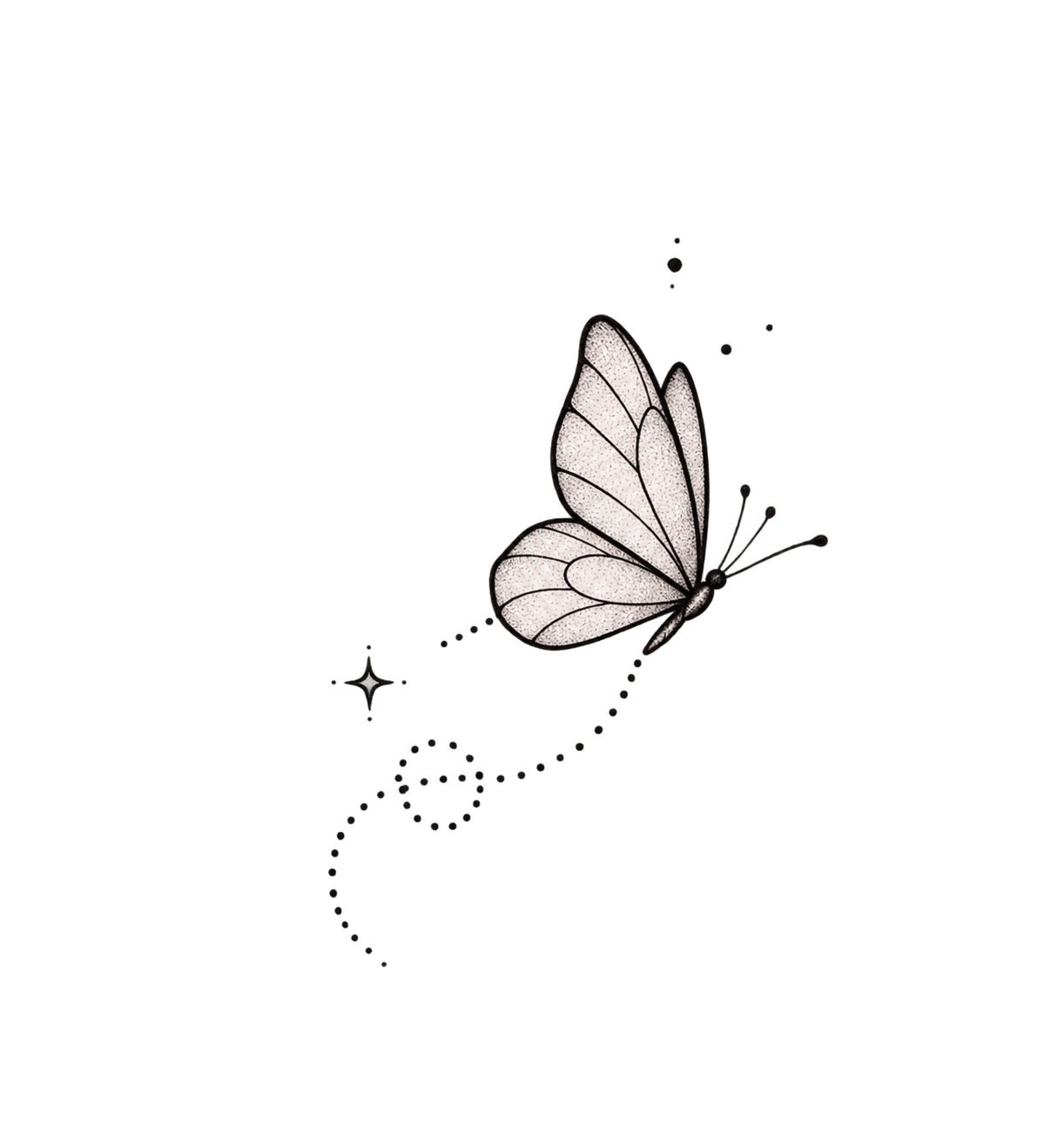
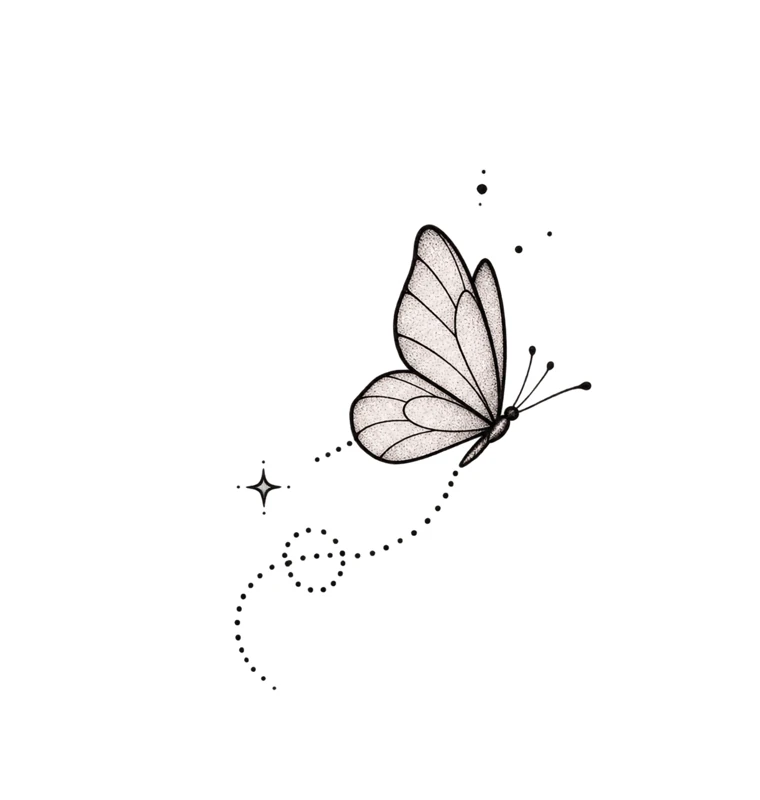
The butterfly sits at the upper end of the composition, with its wings angled upward. Below it, the dots curve and form a loose loop. The star sits off to one side. Together, those details create an informal path rather than a symmetrical border.
If you like the specific reference, pay attention to the spacing between the butterfly and the loop. Compressing that space can make the marks look like a dense cluster. Stretching it can make the trail feel disconnected. Ask to compare a complete version with a shorter trail before deciding which suits the available area.
Decide how much should be visible
Hair is part of the reference's framing. The photograph shows the ear and a tied-back hairstyle, which reveals the motif clearly. Your normal hairstyle may cover some or all of the drawing. Check the proposed position with hair both up and down if occasional visibility matters to you.
Glasses, earrings, and other accessories also change the visual context. Bring or wear the ones you use most often so the artist can see the whole area. That does not mean the tattoo must match your jewelry; it simply gives you a more realistic view than a cropped inspiration image.
Treat small as a design constraint
The butterfly, star, and trail need to remain distinguishable as separate elements. At a compact size, fewer wing veins or fewer dots may be a better choice than scaling down every detail. The silhouette should still feel intentional when you look at it without enlarging the image.
Avoid choosing the final size from a label such as tiny, minimalist, or micro. Those words describe a look, not a measured specification. The photograph has no reliable ruler. Ask the artist to show actual-size versions and explain what they would simplify in each one.
Keep the meaning open
A flight trail can suggest a journey, a moment of freedom, or simply movement. A star can be a decorative accent rather than a coded symbol. You can choose a personal interpretation, but the design does not have one fixed meaning that a wearer must accept.
If you want to add an initial or date, decide which existing element it replaces. Adding another small mark to an already compact composition can make the hierarchy less clear. A single well-chosen detail usually communicates more than a collection of tiny symbols that each require an explanation.
Use the download to mark your preferences
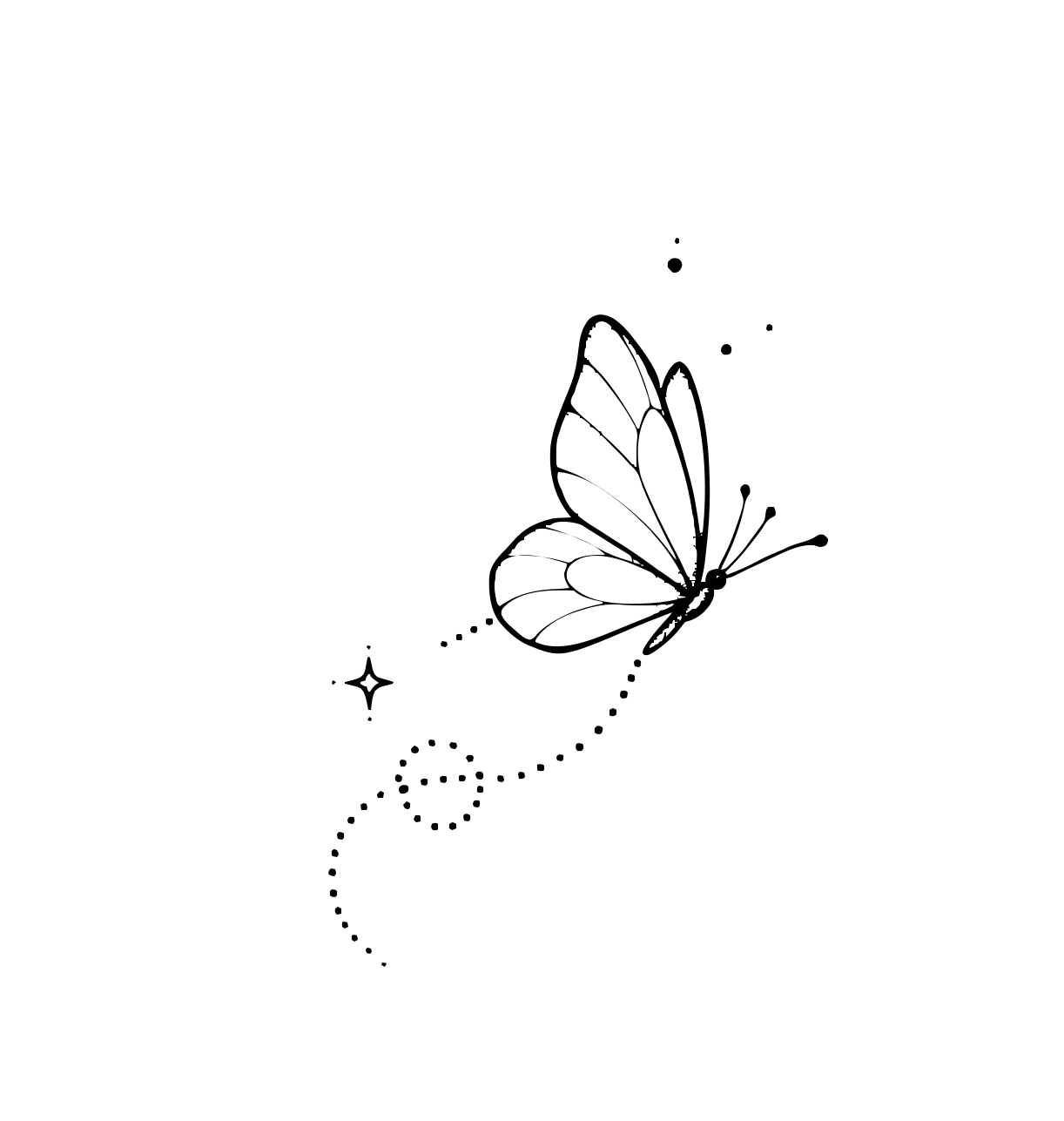
The free reference pack includes an isolated reconstruction, a JPEG, a simplified SVG trace, and printable sheets. Compare the loop, star, wing angle, and dot spacing with the original image. The reconstructed version is a planning reference and may differ in small details.
Mark whether you want the star, the full loop, and the scattered dots above the butterfly. Take those choices to an artist who can assess the placement and prepare a final drawing. The files do not establish exact size, technique, or suitability and are not a finished transfer stencil.
A few useful answers
Can I use only the butterfly?
Yes. Removing the trail and star creates a simpler, more compact design. Ask to see it positioned separately rather than just erasing details from the same layout.
Will it always be hidden by hair?
That depends on your hairstyle and exact placement. Compare the paper layout with your usual hair positions rather than relying on the source photograph.
Yours to take to the artist
Your free reference pack.
Keep the idea, mark your preferences, and discuss the final drawing with your artist. Includes PNG, JPEG, a simplified SVG trace, A4 and US Letter sheets, and the supplied source image.
Download the free reference packA reconstructed artist reference, not exact original artwork or an approved stencil. The SVG simplifies detail. Personal-use terms apply.
Editorial note: this is visual analysis of a supplied illustrative design. Suggested meanings are personal interpretations. Reconstructed references may differ from the source and need artist review. This is not medical advice, tattooing instruction, or evidence of healed results.
Build your artist brief · Compare placements · Suggest a correction